Set a foundation with NACCHO’s Culture of QI Roadmap and Self-Assessment Tool
When an organization or multisector partnership establishes a culture of quality improvement or continuous learning, it’s second nature for team members to always ask questions and look for ways to improve. This inclination to learn and improve is particularly useful when a partnership or coalition expands to focus on new issues, when resources are tight, or when you bring in new partners or sectors.
The National Association of City and County Health Officials (NACCHO) has guidance for developing an organizational culture of quality, called the Roadmap to a Culture of QI, which encourages assessing your agency or coalition against the characteristics in each phase of the roadmap and across each of the six foundational elements of a quality culture using NACCHO’s Organizational Culture of Quality Self-Assessment Tool (SAT) (request the full assessment tool here).
The SAT helps organizations, multisector community partnerships, coalitions, and health departments determine if they have structures and policies in place across the six foundational elements that enable a culture of quality or continuous learning by asking the following questions:
● Are staff (or partners) empowered to infuse QI into their day-to-day routines? What does this empowerment look like?
● Do staff (or partners) have goals and expectations they can understand and work toward?
● Do staff readily share information, input, and ideas?
● Is there regular communication about goals, successes, and challenges?
● Are there processes for feedback?
● Do we regularly test and evaluate changes to continuously improve?
● Do we use data to help make decisions?
After completing the SAT, consult NACCHO’s QI roadmap for targeted resources for each foundational element of QI culture. The roadmap also offers examples of existing health department QI plans that your partnership can adapt as you take the next step and establish clear goals and expectations for your QI work.
|
“The Learning to Action Log allows my team and partners to make a mindset change on their role and strategy toward health equity.”
-Multisector community partnership, Improving SDOH–Getting Further Faster Initiative grantee
|
Imagine this scenario: Your multisector community partnership piloted a new physical activity program at three recreational centers in the city. You’re getting pressure from leadership because attendance is consistently low. But you know from community input that residents want more exercise options. Unless you quickly get to the bottom of what’s not working, department leadership could cut the program. Where do you start?
The Learning to Action (L2A) Log can help your partnership rapidly evaluate activities and gather the information you need to make changes and pivot quickly to a better approach. It’s powerful because busy teams often get caught up in management and measurement and forget to ask “why?” The L2A Log reminds teams to pause to ask questions: Why did something happen the way it did? What can we learn from what happened? How can we apply these insights?
Learning and reflection prompts featured in the L2A Log
The L2A Log consists of a simple table for documenting activities; reflecting on your experiences; considering how to adapt, change, and learn more; and then articulating a feasible next step. The tool also includes a flowchart with prompts to help partners and teams probe deeper and have productive discussions as they reflect.
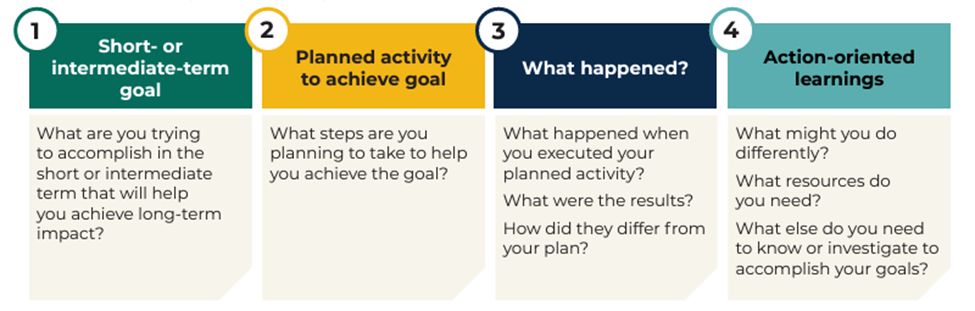
Guiding questions featured in the L2A Log
Because the L2A Log starts by tying activities to your partnership’s goals, it helps ensure your initiatives are contributing to the larger impact you’re trying to make. Using this process can also help you identify different perspectives within your multisector community partnership and achieve consensus on what to do next. Furthermore, by writing down what you learn, the L2A Log creates a record that you can refer back to.
To use the L2A Log, download the worksheet. Also check out the microlearning video on our GFF resources page, which walks through the tool and demonstrates how to use it.
Use communication strategies to foster a learning culture
Beyond establishing clear goals and expectations, building a learning culture involves making space for diverse voices and being curious about different perspectives. To successfully embody continuous learning and a culture of quality, people have to feel comfortable sharing ideas and offering and accepting feedback, so it’s important to guide how these interactions happen to promote trust and inclusiveness.
Establishing communication norms in your partnership can foster this culture. Setting this foundation is especially critical for building and strengthening multisector community partnerships, which by definition involve different organizations, each with their own communication styles and practices. You’ll find many ways to accomplish this, such as:
● Make regular time for reflection and learning by incorporating reflection questions (such as those listed in the L2A Log) into recurring meetings or by scheduling additional meetings to check in and process individuals’ and partners’ experiences.
● Create meeting norms that promote a sense of safety and freedom to speak up during challenging discussions and focus on collective problem solving and accountability. Some ways to do this include verbalizing that it’s acceptable for teammates to share thoughts that aren’t fully formed yet, allowing everyone to share their full thoughts before moving on, and asking people who haven’t spoken up if they’d like to contribute.
● Establish expectations about the type of language used in discussions and define shared terminology to improve interactions and communication. For example, you might prioritize use of person-first language or come to consensus on definitions for key concepts in your work, such as “community health” or “health care.”
● Give everyone a turn to speak and practice active listening to foster inclusion.
Prioritize continuous learning
Continuous learning is an ongoing process that requires time and effort. To be successful, everyone (especially leaders) must make it a priority. Whether your partnership starts with the L2A Log to improve specific activities or commits to adopting a culture of continuous learning with the QI Roadmap as your guide, you’ll learn as you go what works best for your partnership—and what brings the greatest benefit to the communities you serve.